Now that 2010 is closed out, I just wanted to take a second and round up a batch of links to various projects that I was involved with and get them all lumped into a 'splosion of game audio. Every single one of them was made better by the involvement of others, and for that I am thankful.
It is truly a beautiful thing to work along side such creative individuals and to be able to share the common goal of engaging people in the art of sound. I hope that the new year comes with new prospect, and that you will all continue to shape and inform the future of interactive sound to the fullest.
Best to all in 2011!
Audio Implementation Greats
Audio Implementation Greats #10: Made for the Metronome
Audio Implementation Greats #9: GRAW 2 MP: Dynamic Wind System
Audio Implementation Greats #8: Procedural Audio Now
Audio Implementation Greats #7: Physics Audio [Part 2]
Audio Implementation Greats #6: Physics Audio [Part 1]
Audio Implementation Greats #5: Ambient – The Hills are Alive
Audio Implementation Greats #4: De’ Bug and the DSP Sound-Bomb
Audio Implementation Greats #3: Crackdown – Realtime Worlds
Audio Implementation Greats #2: Audio Toolsets [Part 2]
Audio Implementation Greats #1: Audio Toolsets [Part 1]
Game Audio Podcast
Game Audio Podcast #7: Mushroom Men - Made for the Metronome
Game Audio Podcast #6: Independent Sound Libraries
Game Audio Podcast #5: Mini-Episode
Game Audio Podcast #4: Procedural Game Audio
Game Audio Podcast #3: Interactive & Dynamic Music
Game Audio Podcast #2: Footsteps & Foley, Design & Integration
Game Audio Podcast #1: Ready, Set, GO!
Lost Chocolate Blog
AES 2010: game Audio Track Wrap
Procedural Sound Now [LINKS]
Content is King - Rise of the Independent Sound Library
“Game Audio Basics” March Issue of Mix Magazine
Footsteps – Informal Game Sound Study
The Next Big Steps In Game Sound Design - Gamasutra
Conan - Melee System Overview
Game Audio Relevance
Game Audio Relevance 005
Game Audio Relevance 004
Game Audio Relevance 003
Game Audio Relevance 002
Game Audio Relevance 001
(I kindof felt like I was busy this year, but the above only represents my un-billable hours)
Games Shipped
Back to the Future: Episode 1
Poker Night at the Inventory
Star Wars: The Force Unleashed II
Sam & Max: Devil's Playhouse
Puzzle Agent
CSI: Crime Scene Investigation - Deadly Intent
Wow, just wow.
Future
GDC 2011 Speaker: Footsteps - Informal Sound Study
Hope to see you soon!
-lcl
Showing posts with label Audio Implementation Greats. Show all posts
Monday, January 03, 2011
Friday, September 24, 2010
Procedural Sound Now! [LINKS]
Procedural Sound is a topic that I feel has a great potential to solve some of the challenges facing game audio. Whether it's the dynamic composition of music in real-time, geometric sound propagation modeling , or harnessing already available simulations to create approximations of sound using synthesis, there exists a tremendous amount of solutions to the problems of how to make our virtual worlds more directly reactive and immersive. It's with optimism that I set upon trying to raise awareness of some of these techniques and technologies available outside the confines of console specific runtimes. It's my hope that by looking outside of our industry we can catch a glimpse of the future for game audio, and set our sights on some new ways to provide engaging, dynamically reactive, and emotionally resonating interactive sound.
In a companion article entitled "Procedural Sound Now!" at DesigningSound.org as part of the Audio Implementation Greats series, I've made a case for a return to the formative years of game audio with an eye towards new developments in synthesis and procedural. The article wraps with a QA with three audio professionals working with procedural sound in some capacity.
This post is an attempt to round up the cadre of links I was able to unearth in relation to the article. You'll get a bit of sound modeling, some procedural, a bit of music, white papers, and research materials. Keep an eye on this space over time, as I hope to keep adding to this list as a resource for people who are interested in new developments and articles. Please send along any further suggestions or post below in the comments section.
Additionally we have released Game Audio Podcast Episode 4: Procedural Game Audio - Head over and subscribe via iTunes and give it a listen!
It's taken the help of many dedicated sound professionals to bring to light and assemble the different pieces of the puzzle. My deepest thanks and gratitude go to: Anton Woldhek, Karen Collins, Andy Farnell, David Thall, Mads Lykke, Francois Thibault, and all of the inspirational audio futurists pushing the envelope.
Andy Farnell:Andy Farnell: Audio, code and tutorials on synthesis
(See links section for additional jumps)
Andy Farnell: Synthetic game audio with Puredata
Andy Farnell: An Intro to Procedural Audio in Games
Andy Farnell: Designing Sound
Stefan BilbaoStefan Bilbao: Conference Proceedings
Stefan Bilbao: Numerical Sound Synthesis
Kees van den DoelKees van den Doel: Publications
Sounds of Shapes
Mark GrimshawMark Grimshaw: Publications
Game Sound Technology and Player Interaction: Concepts and Developments
Dylan Menzies:Dyland Menzies: Publications
Phya: Physical Audio for Virtual Worlds
Phya and VFoley, Physically Motivated Audio for Virtual Environments
General:Procedural Audio.com Papers
Nicolas Fournell
Leonard Paul: Video Game Audio
Cosyne Synthesis Engine
USO: Generative Music: an interview with Peter Chilvers
Create a scalable and creative audio environment: middleware project PLAY ALL
Procedural Audio for Game using GAF
Master of Sound: Automatic Sound Synthesis from Fluid Simulation
FOLEYAUTOMATIC: Physically-based Sound Effects for Interactive Simulation and Animation
Audiokinetic: Sound Seed
FMOD Designer
Princeton SoundLab: Publications
Banded Waveguides and Propagation Modeling: Efficient Physical Models of Solid Objects
A Brief Overview of Physical Modeling
Perry Cook: Real Sound Synthesis for Interactive Applications
Procedural Audio in Computer Games by Mads Lykke
Sound Synthesis in Game - MuCell
Realistic Real-Time Sound Re-Synthesis and Processing for Interactive Virtual Worlds
Spore:
Brian Eno with Wright on Spore and Generative Systems
Spore Anthem Creator Tutorial
Spore City Music Planner from GDC 08
Aaron Mcleran: Procedural Music for Spore
The Beat Goes on: Dynamic Music in Spore
The Generation of Procedural Generation
Liveblogging Procedual Music in Spore @ GDC08
Audio Interview with Cyril Saint Girons (Audio Engineer)
Brian Eno: Before and After Darwin
Brian Eno: Generative Music
GAMMA:Geometric Algorithms for Modeling, Motion, and Animation
GAMMA - Projects Overview: Sound Synthesis and Propagation
SIGGRAPH 2009: Interactive Sound Rendering Presentations and Proceedings
Symphony: Interactive Sound Synthesis for Large Scale Environments
Synthesizing Contact Sounds Between Textured Objects
Sounding Liquids: Automatic Sound Synthesis from Fluid Simulation
AD-Frustum: Adaptive Frustum Tracing for Interactive Sound Propagation
Efficient and Accurate Numerical Simulation of Sound Propagation
Precomputed Wave Simulation for Real-Time Sound Propagation of Dynamic Sources in Complex Scenes
Next Generation Virtual Musical Instruments Using Multi-touch Interfaces
Interactive Sound Propagation in Dynamic Scenes Using Frustum Tracing
Fast Edge-Diffraction for Sound Propagation in Complex Virtual Environments
An efficient time-domain solver for the acoustic wave equation on graphics processors
Fast Geometric Sound Propagation with Finite Edge Diffraction
RESound: Interactive Sound Rendering for Dynamic Virtual Environments
Direct-to-Indirect Acoustic Radiance Transfer
Cornell
Sound Rendering for Physically Based Simulation
Rigid-Body Fracture Sound with Precomputed Soundbanks
Harmonic Shells: A Practical Nonlinear Sound Model for Near-Rigid Thin Shells
New Scientist: Virtual crashes and clatters get real
Crash, bang, rumble! Bringing noise to virtual worlds
Harmonic Fluids
Other:Fast Modal Sounds with Scalable Frequency-Domain Synthesis
Precomputed Acoustic Transfer: Output-sensitive, accurate sound generation for geometrically complex vibration sources
I hope that get's you started on the wide world of Procedural Sound and Synthesis.
If you have any additional suggestions for links to interesting materials please drop a line or comment.
Proceduraly yours,
-lcl
Tuesday, March 16, 2010
Footsteps – Informal Game Sound Study
THE STOCK MARKET
Lately, I've been taking stock. Not the usual “What have I done with my life?” or “Where is everything headed?” (although those questions perpetually tumble around my brain stem on a regular basis); I somehow found myself obsessed with the minute details of movement sound and system design. If you're working in games today, chances are good that you've recorded, implemented, or designed systems for the playback of character footsteps and Foley at some point during the course of your career. It's even more likely that you've played a game where, at some point during your experience, footstep sound wrestled your focus away from the task at hand and demanded your listening attention.
Yet, let it be said, all footsteps are not created equal – which seems obvious given that no two games are exactly the same, neither should their footsteps or the way in which they are implemented be (necessarily) the same. At the end of the day, as content creators, we should be slaves to the games we are helping to make and not showboating unnecessarily in our own art by accentuating or spending time of things that have little consequence outside of our own satisfaction; however, for a sound type that may be heard for countless hours across every level in a game, surely they deserve more than a passing thought. (or maybe I'm trying to justify my current obsession!)
Now that that's been said I want to take a moment to recognize the ubiquity of footsteps across almost every genre – they're everywhere! It's with the utmost care and delicacy that this simple aspect of sound be handled so as to lend itself to player immersion, lest the veil of realism drop and expose the pixels on the screen as what they truly are: groups of flashing lights to stimulate the visual cortex. Oops...SPOILER!
*A Squid Eating Dough in a Polyethylene Bag Is Fast and Bulbous, Got Me?
So it is with this soft eared attention to detail that we will delve into the details of movement design from a systems perspective, and try to carve out some common practices. When jumping (hah) into the throng of movement oriented sounds the core components boil down to: Footsteps and Foley.
THE FAIRY TALE
Once upon a time it was enough to provide a small number of step-only audio files that could be sequenced or randomized in time with the foot falls of the player on screen. In the not so distant past, it was not uncommon to deliver these same steps with a portion of Foley movement embedded into each to help add character to the movement. As available memory and increased polyphony became available, the ability to split these elements into separate assets that could be layered and recombined at runtime by the audio engine became a reality that many have been quick to adopt.
Now that we have these elements separated and playing back independently, we are free to swap out material and clothing types without redelivering our step-only content for each outfit and surface material type. We can keep our content footprint (lol) down by not having to exponentially create combinations, and the flexibility we gain opens up a greater diversity when these elements are shuffled on top of each other during character movement. Coupled with the ability to randomize pitch, volume, and low pass filter between a set of values this content now becomes a seemingly endless array of diversity for any given action.
Developing in parallel to these audio aspects were the refining of animations, increased subtlety of character movement, and increased depth of player control: all of which helped unlock a level of detail necessary to bring Footsteps and Foley towards a model approaching reality. Games that are now reaching for a level of realism have been set free to further granularize their sound content sets to include: additional step types beyond walk or run, to allow for the changing of clothing types, to increase the number and types of movements available to the player at a given time, and expand the list of surface materials a character may be able to move across.
Sometimes writing about sound can be like dancing about architecture, and so I've assembled a series of game video's that focus specifically on footsteps and Foley within the current generation of games in an attempt to provide perspective. While some might cry foul at the removal of music in the examples presented, the goal was not to assess footstep mix related issues (which could fill up a whole other study) but to allow for a distanced abstracted critical listening experience. In games where as the player you find yourself running for extended periods with only ambient sound and your perpetual footsteps to keep you company it makes solid sense to focus on the persistent ticking of heels and toes whilst traversing the landscape. If, as the player character, you would never find yourself walking or creeping stealthily between places, then the complete lack of subtlety for this aspect of footstep sound can usually be forgiven.
FREE RUNNING/ PARKOUR
A comparison of the 3 titles whose core gameplay is centered around the players ability to deftly traverse the environment turned out to present a stunning example of aesthetic choices in sound design, as well as showcasing a high level of detail inherent within each of the system designs. While they all focus on player movement and Foley in a similar way, each communicates a style that I feel services the visual side of the equation in a complimentary way. Where Assassin's Creed 2 is the most fluid and “real” sounding, the added iconic/ earconic elements in the Prince of Persia Foley (recognizable – for example – in the identifiable hand grabbing the ring sound) really lent a sense of satisfaction to a successful execution of this action.
“the footstep system uses more than 1,500 original recorded samples. We managed 22 surface materials, with 14 different step intentions — sneak, walk, run, jump, land, pivot, et cetera — including three to eight variations for each intention per surface.”
In contrast, Mirror's Edge's movement sound was delivered stylistically in compliment to it's grand visual design – stark, clean, and clearly bristling with crispy audio detail. From an interview at Gamasutra with Owen O'Brien, senior producer on DICE's Mirror's Edge:
“In most games, footsteps are a pretty simple thing to add, but running and moving was so integral to Mirror's Edge that we had to create a huge library of footsteps and a system to manage them. We had them for different speeds, different surfaces, different landings; the list goes on and on.”
SQUAD/ GROUP BASED
Video: Footstep Study – Dragon Age
The squad or group based gameplay of Dragon Age and Mass Effect introduces it's own set of challenges when it comes to movement sounds. In support of the player character, you may have have additional party members following your every move. This means as they trail behind you in close proximity, their footsteps can be heard in a chorus of movement mirroring your progression through the level. This can be good and bad, depending. It's likely that, in order to combat the repetition of playing the same sound files twice, the content requirements demand an increased number of variations to keep things from sounding too similar. Also, it becomes critical that the AI for your group members be intelligent enough to keep pace smoothly without the walk, stop, walk stutter which presents itself when the player is walking slowly. Hearing the AI react poorly in this situation is just as bad as watching an AI walk endlessly into a wall – both expose the underlying shortcomings of the systems behind the action and contribute to a lost sense of immersion.
In a list of suggestions for making Mass Effect 2 a better experience, one player cited “less generic footsteps” as a possible solution:
“I never realized how important it is to hear the footsteps of your character while you are stomping around in a game. To be more precise: how important it is to hear those footsteps reflect the surface that you are walking on....With the amount of walking that you do in Mass Effect, the lack of variety can really get on your nerves. Even changing the pitch of the sound somewhat for different surfaces would improve things dramatically.”
The same could be said about many games where a small number of surface types are repeated throughout. Aside from the battle against the grey-ification of our game worlds, as sound professionals we may be able to help by suggesting variances to surface types that would be reflected in the sound of player movement.
One area that Dragon Age succeeds greatly, is in changing out Foley movement sounds based on the type of armor equipped on both the player and any following party members. By enabling the layering technique mentioned above, Bioware was able to communicate the change of armor through sound, and helped add a level of audio feedback to their system. This feedback, while seemingly inconsequential, enables the player to feel connected to their decisions when reflected back at them not just visually in the armor displayed on-screen, but by the resulting sound when moving. The small touches of detail help to sell the player's role in defining the soundscape in their game, and gives a greater sense of involvement in character progression.
1ST / 3RD PERSON
Video: Footstep Study – Fallout3
Video: Footstep Study – Borderlands
Video: Footstep Study – Fracture
Video: Footstep Study – Crackdown
The first person perspective brings with it a certain level of disconnect. The oft-cited “floatiness” inherent with the inability to actually see you feet as the player can be difficult to anchor – with any sense of physicality – to the environment. Optimistically, this is a perfect opportunity for sound to swoop in and save the day by providing an audible feedback representation of the action on screen. While the immersive aspect of the first person viewpoint in games is widely debated, I don't think anyone would argue with the the addition of footstep sounds as providing a necessary connection to the game world.
When I first assessed the footsteps in Crackdown I commented in this thread at the Game Audio Forum that “while I think (the footsteps) sounded ok when running/ running fast...the slow walk did have too much thunk to sell the finesse of the movement.” Thanks to a revelatory response by Tom Todia at Engine Audio, I was able to peel back the academic wax that had accumulated in my ears and remind myself that the game is all about grand, larger-than-life gestures. I can imagine spending almost no time in consideration of actually walking during normal gameplay in Crackdown, which I think highlights what was likely a creative decision that the developer needed to make regarding what was (more) important: the addition of walk steps or increased variations of giant explosions!
In a blog post by Raymond Usher at Gamasutra, he discusses footsteps and “the expectation (from the development team) that we 'need' footsteps” and how that might take focus away from other area's that may be more important.
In a discussion of advanced Modern Warfare 2 perks, the subject of changing the footstep sounds as a part of gameplay is overviewed:
“These advanced perks provide a small secondary benefit, usually of little consequence, to the perk’s main function. For instance, the first game had a perk called “Dead Silence” that muffled the sound of that player’s footsteps. While theoretically useful for stealthy players, in practice it was easily outclassed by every other perk in that tier. In the sequel, silent footsteps became a secondary effect of the pro version of “Ninja” (invisibility to heartbeat sensors).”
Another interesting example I stumbled across in this group comes in the form of Fallout 3 Audio Director Mark Lampert's decision to include a slider in the menu options specifically for adjusting the footstep volume. Where it has been common to see volumes for Music, Sound, and Voice, this ability to adjust the footstep sound in relation to the rest of the mix to suit user preference is an interesting addition.
MELEE COMBAT
Video: Footstep Study – Brutal Legend
Video: Footstep Study – Star Wars: The Force Unleashed
Video: Footstep Study – Conan
Video: Footstep Study – Star Wars: The Force Unleashed
Video: Footstep Study – Conan
In games that focus on melee combat, or are otherwise consumed with bringing across multiple systems while catering significantly towards cutting a path through a sometimes endless hoard of baddies, the role of footsteps is often downplayed by design with wall to wall carnage. Which is to say that detailed player movement sound is certainly not the focus for any sustained length of time. For each character in Star Wars: The Force Unleashed we had about 10-16 file variations per step type randomly shuffled across 20 materials for walk, run, and land. In Conan we had 4 file variations per foot across 9 materials and 2 step types. There is no magic number when it comes to deciding at what point you have enough variation, often it becomes a complicated equation of space vs. perceived need for diversity.
RPG
In the current generation we have 10-20 times the memory of last gen, our tools are more intuitive, and our understanding of the process is greater. What I've come to find in my assessment and experience is that despite this ability, there seems to be two schools of thought regarding footsteps in the current generation, of which Lost Odyssey is currently my poster-child.
1. Maximum variation: Both at the file level (lots of steps) and through randomized pitch and volume.
I think the idea of maximum variation is covered pretty well above regarding our current capabilities, but the idea of Iconic footsteps might still be a bit vague. Essentially the idea of is that, as an aesthetic choice, a minimal amount of footstep variations are chosen because they exemplify the particular character and step type without the need for randomness or variation. The thinking seems to be that if exactly the right (for example) two footsteps for a given step type are chosen, then the action can succeed with minimal variation and the sound of the character can be defined iconically by the sound instead of bowing to a perceived reality.
While the choice to go Iconic for footsteps could be due to limitations of RAM, I'm finding it difficult to believe that this is the case, and so I've started to think that it is a conscious design choice. I'm also trying hard not to label it a "last gen" technique and chalk it up as a hangover from a time when you were lucky to get 2MB of RAM for the entire level of a game. I would like to believe that this is a choice that some designers are making, instead of a response to limitations – especially because of the pervasive presence of footsteps throughout the entirety of a game makes it hard to ignore and certainly is a decision that must be consciously made.
I have no info about the technical choices and tradeoff's that were made in the creation of the footsteps for Lost Odyssey, but it's easy to hear that they have implemented a smaller more iconic set of footsteps for each step and material type with little to no pitch or volume randomization. This is especially apparent when climbing up and down ladders. That said, they sound exceedingly appropriate and are designed to a high level of detail.
(The interactive bell ringing playground equipment is also a must see/hear!)
THE CONCLUSION
At the end of the day, it should be about building appropriate systems that support well designed content in order to best portray the action on screen as a way to sell the players role in the environment. Whether this comes with or without fast bulbous squids, it all boils down to the same thing: we're all slaves to the game.
Until next time!
Special thanks to contributers to the contributers to the Game Audio Forum post that fueled my fire and our special guests on Episode 2 of the Game Audio Podcast where we discussed some of these things.
**EDIT**
I ended up spinning this into a talk given at GDC 2011 and further reprised it at my local IGDATC meeting.
Here's the video:
Concept Art © Aaron Armstrong and extra special thanks for console's, insight, and game saves.
*That's right, The Mascara Snake. Fast and bulbous! Also, a tin teardrop!*Thank you Captain
Special thanks to contributers to the contributers to the Game Audio Forum post that fueled my fire and our special guests on Episode 2 of the Game Audio Podcast where we discussed some of these things.
**EDIT**
I ended up spinning this into a talk given at GDC 2011 and further reprised it at my local IGDATC meeting.
Here's the video:
Concept Art © Aaron Armstrong and extra special thanks for console's, insight, and game saves.
Wednesday, January 13, 2010
Audio Implementation Greats Series Launched!
In an effort to round up some of the coolest tricks I've heard about (and can repeat!) in game audio, I've started a series of articles focused on the technical side of implementation over at DesigningSound.org
The first couple of articles provide a bit of a history lesson on Implementation Toolsets by going over some of the publicly available Audio Middleware that has been available, and several examples of Proprietary Tools that have been released into the wild.
I've been wanting a higher profile location to share some of these things with people who might be interested, and Miguel over at Designing Sound has graciously allowed me to present the series on what has become a fantastic resource for Film and Game Sound information. It's my hope that by shedding light on some of the techniques that may have been overlooked in the current generation of games, we can all push forward and raise the bar for interactive audio and continue driving the tech to the far ends of creativity.
-lcl
Thursday, November 12, 2009
Conan - Melee System Overview
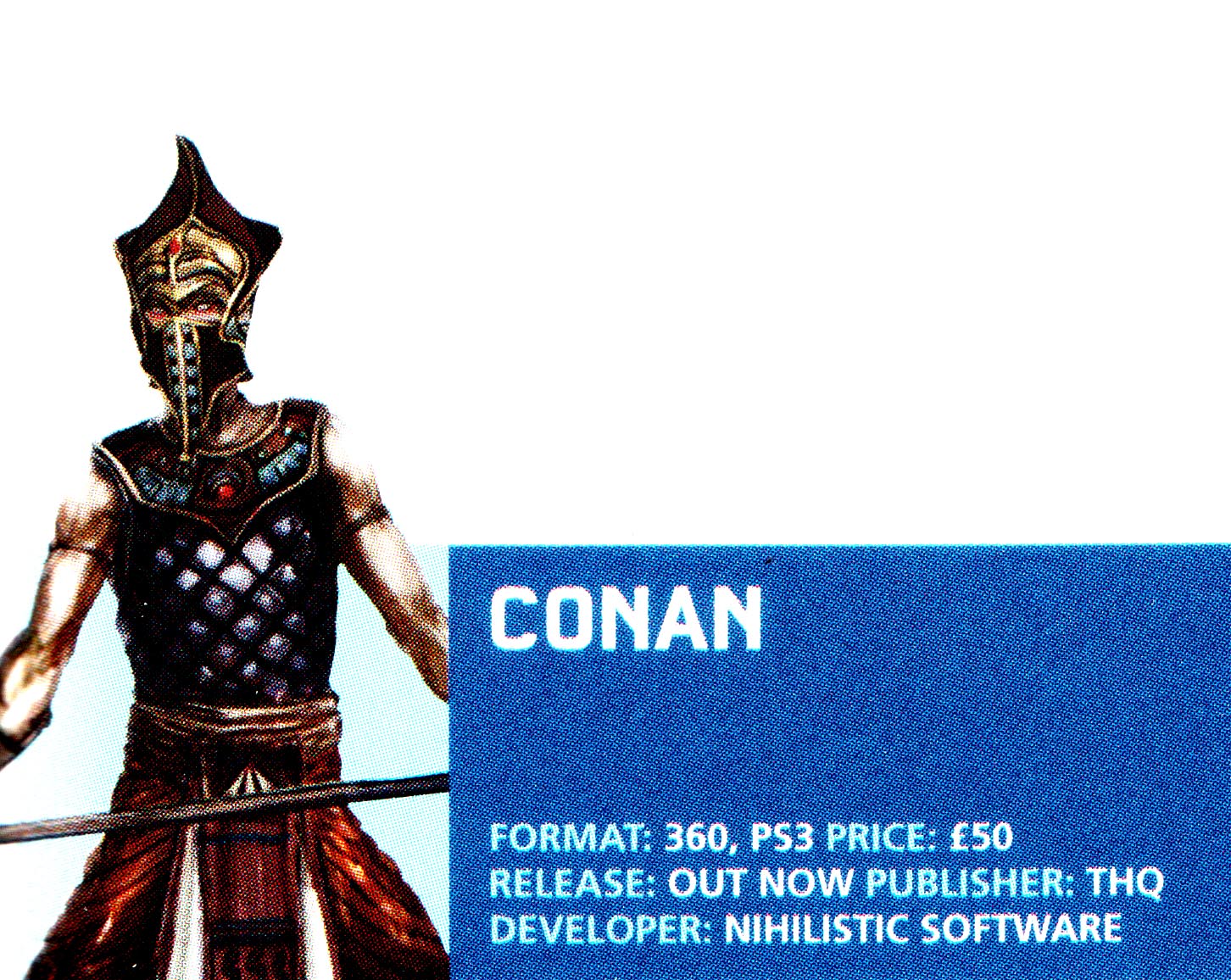
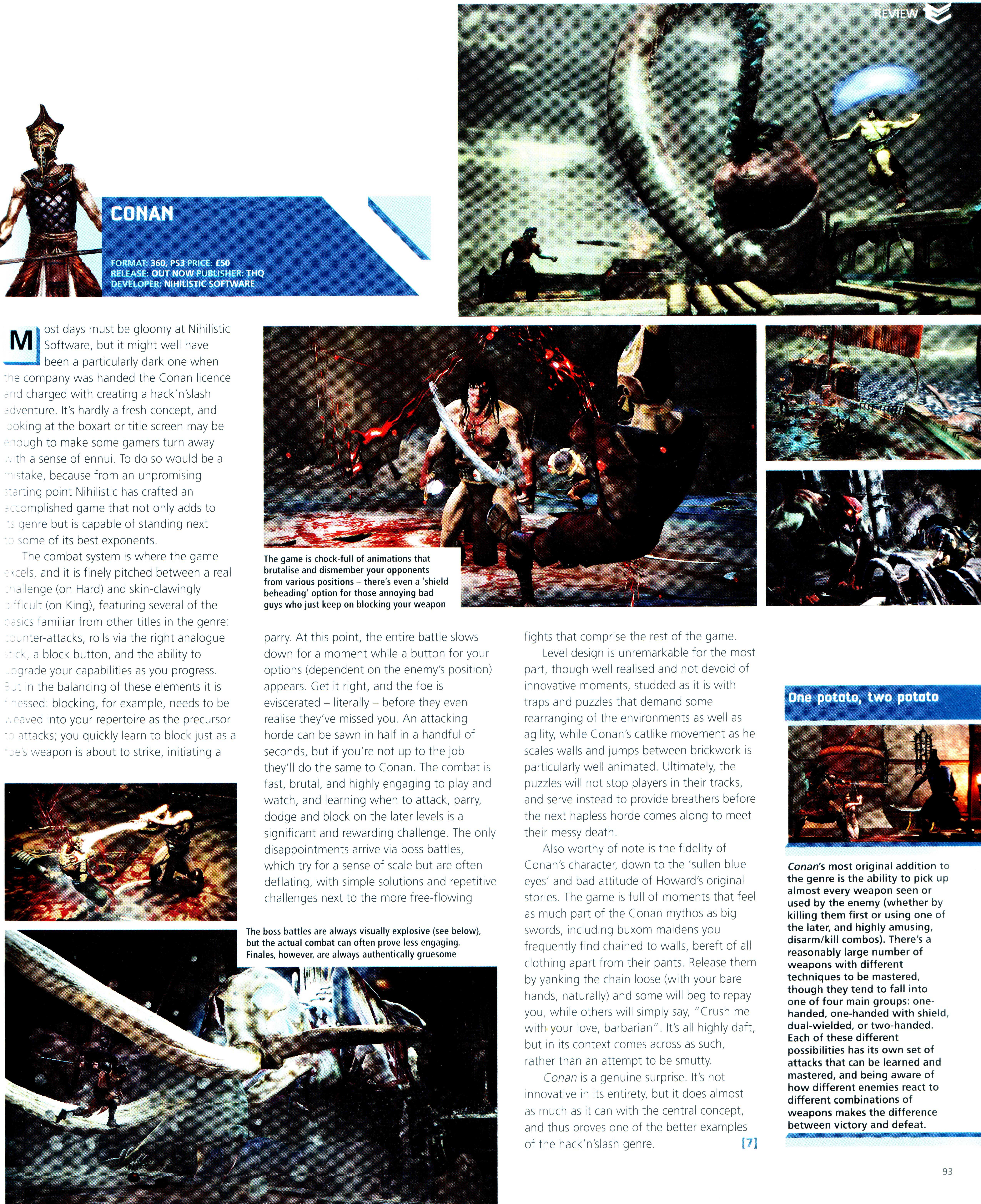
We did something interesting with the impacts and deflection for the 9 weapons and 8 melee types used in the X360/PS3 title Conan for Nihilistic Software.
For the uninitiated, Conan is a brutal hack and slash combat game that combines scalable abilities upgrades with strategized battle interactions. You can get an overview of the gameplay in this article: Edge Review - Conan
I'm attempting an overview of the melee specific weapon system we implemented using FMOD Designer and other Nihilistic proprietary in-house tools. Throughout the process, the overarching goal was to add diversity and brutality to what is the main focus of the game. The use of content level variation, pitch and volume randomization, and elemental layering allowed us tomake the sounds of combat non-repetitive over the course of the game.
In the system that we built, weapons were able to perform the following actions:
Blocked Break
Blocked Heavy
Blocked Light
Deflect
Hit Heavy
Hit Light
Parried
Swing
In a game so heavily focused on combat where you spend each level mowing down enemies from start to finish, we knew that we had to make a combat system that reflected the core gameplay objective of giving the player diversity while making the sound varied enough to prevent fatigue.
Hit's are defined as actions that impact an NPC and cause damage, and we were tracking both Light and Heavy hits.
We used a game parameter for surface type that was passed from the games collision detection to FMOD in order to track what surface was being impacted. The FMOD Event that was triggered was based on the weapon type being used by either the player or NPC and whether the hit was Heavy or Light or Deflected, it then received it's material type parameter and jumped to it's correct position within the FMOD event where it then layered the impact sound depending on weapon and material type.
For a Hit Light or Heavy we layered the following things where applicable:
Base Layer (Weapon type specific)
-Axe Dull Heavy
-Axe Dull Light
-Axe Metal Heavy
-Axe Metal Light
-Axe Solid Heavy
-Axe Solid Light
-Sword Dull Heavy
-Sword Dull Light
-Sword Metal Heavy
-Sword Metal Light
-Sword Solid Heavy
-Sword Solid Light
-Sword Wood Heavy
-Sword Wood Light
Hit Accent (Material Specific)
-Flesh Heavy
-Flesh Light
Hit (Thud) Actor Specific
-Flesh Boss Specific
Hit Ringoff (Weapon type specific)
-Axe
-Sword
Hit Blood level
-Blood Splash Small
-Blood Splash Medium
-Blood Splash Large
-Blood Splat Small
-Blood Splat Medium
-Blood Splat Large
Hit Special Ringoff (Weapon specific)
-Used for special Conan ringoff
Hit LFE
-Generic
Piling up the above elemental content into an audio middleware tool where everything is recombined at runtime the effects of different weapons and material hit's randomized when trigered sound like this:
Combined Weapon Hit Impacts
-Axe Light Flesh
-Axe Heavy Flesh
-Axe Heavy Stone
-Axe Heavy Armor
-Sword Light Flesh
-Sword Heavy Flesh
-Sword Special Flesh
-Sword Light Stone

For non-damage causing hit's usually specifically involving weapon interaction with the environment, we used a different Event for deflections.
Similar to the Hit system outlined above, we layered the following things when a weapon type deflected off a surface:
Base Layer (Weapon type specific)
-Axe Dull Heavy/Light
-Axe Metal Heavy/Light
-Axe Solid Heavy/Light
-Sword Dull Heavy/Light
-Sword Metal Heavy/Light
-Sword Solid Heavy/Light
-Sword Wood Heavy/Light
Deflect Accent (Material Specific)
-Armor
-Bramble
-Cloth
-Cloth Rip
-Debris
-Glass
-Thicket
-Wood
Deflect LFE
Deflect Additional
-Used for extra heavyness
These were combined at runtime each time the sword deflected off a material in the environment. Additional limiting of the number of voices for the deflect event helped to prevent "stuttering" as the weapons blade tracked through an object. FMOD's Event limiting system is well equipped to handle this aspect of implementation by providing mulitple max playbacks, and max playback behaviors.
Deflect Combined
-Armor
-Bramble
-Cloth Rip
-Debris
-Glass
-Stone 01
-Stone 02
-Stone 03
-Stone 04
-Thicket
-Wood

The system we built for Conan built to the strength of the IP and the genre.
Conan - Melee Combat Sound from d k on Vimeo.
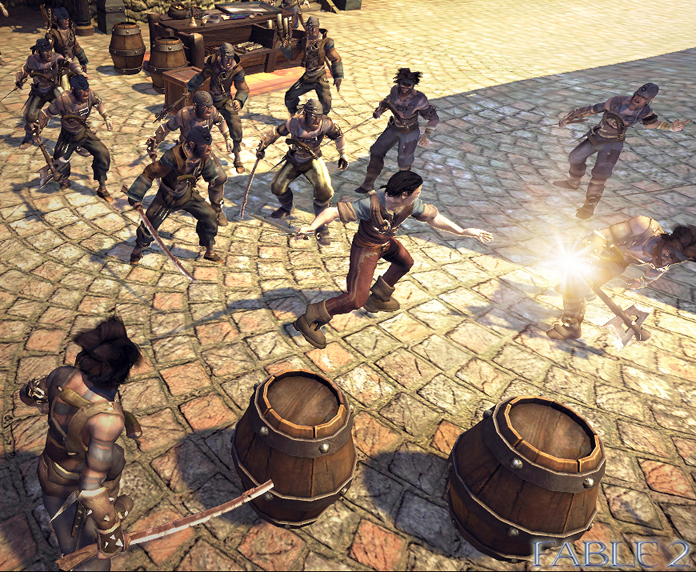
Fable2 - The Way of Layered Weapon Sound
Another game that successfully used the layered Weapons approach was Fable2 by Lionhead. (Microsoft game Studio's) In a talk given by Kristofer Mellroth at GDC 2009 titled: The Audio of FABLE 2: Large Scale Collaboration for Next Gen Games, the weapon system for Fable2 was outlined to illustrate the decisions that were made regarding content, and implementation. The basic building blocks of melee and ranged weapon combat were abstracted at the content level and recombined at runtime using a constantly shifting set of source material controlled by gameplay variables.
In Fable 2 there were 7 types of melee weapons with 5 levels of sound interaction: Swipe, Strike, Scrape, Ring, Block, and Flourish.
Swipe – the sound of the melee weapon swinging through the air.
Strike – the muted hit of the weapon striking any object.
Scrape – the sound of the weapon scraping as it passes through an object.
Ring – the pleasant ring of a weapon that has struck cleanly.
Block – a dissonant clang of the weapon as it collides with another weapon.
Flourish – a special longer, sweetened version of the weapon swipe to convey the sense of a move with greater power.
Sound for these different actions were combined and randomized according to type with weighting and some with the potential to not play when triggered.
For instance when the Player connected a hit on an NPC the game would play a Swipe, followed by a combination of Strike, Scrape, Ring in order to arrive at a coherent impact.
By breaking out the separate elements of each melee type and allowing for content and parameter variation the diversity of swings and impacts are increased. As we continue to move forward with larger worlds that demand less repetition of often repeatable actions, the elemental approach to combat continues to be our greatest asset in driving toward less fatiguing audio.
Also see Video: New Fable 2 Developer Diary Talks Audio
Article: The Sound Design of Fable 2: How We Scaled to Beat the Clock
For the uninitiated, Conan is a brutal hack and slash combat game that combines scalable abilities upgrades with strategized battle interactions. You can get an overview of the gameplay in this article: Edge Review - Conan
I'm attempting an overview of the melee specific weapon system we implemented using FMOD Designer and other Nihilistic proprietary in-house tools. Throughout the process, the overarching goal was to add diversity and brutality to what is the main focus of the game. The use of content level variation, pitch and volume randomization, and elemental layering allowed us tomake the sounds of combat non-repetitive over the course of the game.
In the system that we built, weapons were able to perform the following actions:
Blocked Break
Blocked Heavy
Blocked Light
Deflect
Hit Heavy
Hit Light
Parried
Swing
In a game so heavily focused on combat where you spend each level mowing down enemies from start to finish, we knew that we had to make a combat system that reflected the core gameplay objective of giving the player diversity while making the sound varied enough to prevent fatigue.
Hit's are defined as actions that impact an NPC and cause damage, and we were tracking both Light and Heavy hits.
We used a game parameter for surface type that was passed from the games collision detection to FMOD in order to track what surface was being impacted. The FMOD Event that was triggered was based on the weapon type being used by either the player or NPC and whether the hit was Heavy or Light or Deflected, it then received it's material type parameter and jumped to it's correct position within the FMOD event where it then layered the impact sound depending on weapon and material type.
For a Hit Light or Heavy we layered the following things where applicable:
Base Layer (Weapon type specific)
-Axe Dull Heavy
-Axe Dull Light
-Axe Metal Heavy
-Axe Metal Light
-Axe Solid Heavy
-Axe Solid Light
-Sword Dull Heavy
-Sword Dull Light
-Sword Metal Heavy
-Sword Metal Light
-Sword Solid Heavy
-Sword Solid Light
-Sword Wood Heavy
-Sword Wood Light
Hit Accent (Material Specific)
-Flesh Heavy
-Flesh Light
Hit (Thud) Actor Specific
-Flesh Boss Specific
Hit Ringoff (Weapon type specific)
-Axe
-Sword
Hit Blood level
-Blood Splash Small
-Blood Splash Medium
-Blood Splash Large
-Blood Splat Small
-Blood Splat Medium
-Blood Splat Large
Hit Special Ringoff (Weapon specific)
-Used for special Conan ringoff
Hit LFE
-Generic
Piling up the above elemental content into an audio middleware tool where everything is recombined at runtime the effects of different weapons and material hit's randomized when trigered sound like this:
Combined Weapon Hit Impacts
-Axe Light Flesh
-Axe Heavy Flesh
-Axe Heavy Stone
-Axe Heavy Armor
-Sword Light Flesh
-Sword Heavy Flesh
-Sword Special Flesh
-Sword Light Stone

For non-damage causing hit's usually specifically involving weapon interaction with the environment, we used a different Event for deflections.
Similar to the Hit system outlined above, we layered the following things when a weapon type deflected off a surface:
Base Layer (Weapon type specific)
-Axe Dull Heavy/Light
-Axe Metal Heavy/Light
-Axe Solid Heavy/Light
-Sword Dull Heavy/Light
-Sword Metal Heavy/Light
-Sword Solid Heavy/Light
-Sword Wood Heavy/Light
Deflect Accent (Material Specific)
-Armor
-Bramble
-Cloth
-Cloth Rip
-Debris
-Glass
-Thicket
-Wood
Deflect LFE
Deflect Additional
-Used for extra heavyness
These were combined at runtime each time the sword deflected off a material in the environment. Additional limiting of the number of voices for the deflect event helped to prevent "stuttering" as the weapons blade tracked through an object. FMOD's Event limiting system is well equipped to handle this aspect of implementation by providing mulitple max playbacks, and max playback behaviors.
Deflect Combined
-Armor
-Bramble
-Cloth Rip
-Debris
-Glass
-Stone 01
-Stone 02
-Stone 03
-Stone 04
-Thicket
-Wood

The system we built for Conan built to the strength of the IP and the genre.
Conan - Melee Combat Sound from d k on Vimeo.
Fable2 - The Way of Layered Weapon Sound
Another game that successfully used the layered Weapons approach was Fable2 by Lionhead. (Microsoft game Studio's) In a talk given by Kristofer Mellroth at GDC 2009 titled: The Audio of FABLE 2: Large Scale Collaboration for Next Gen Games, the weapon system for Fable2 was outlined to illustrate the decisions that were made regarding content, and implementation. The basic building blocks of melee and ranged weapon combat were abstracted at the content level and recombined at runtime using a constantly shifting set of source material controlled by gameplay variables.
In Fable 2 there were 7 types of melee weapons with 5 levels of sound interaction: Swipe, Strike, Scrape, Ring, Block, and Flourish.
Swipe – the sound of the melee weapon swinging through the air.
Strike – the muted hit of the weapon striking any object.
Scrape – the sound of the weapon scraping as it passes through an object.
Ring – the pleasant ring of a weapon that has struck cleanly.
Block – a dissonant clang of the weapon as it collides with another weapon.
Flourish – a special longer, sweetened version of the weapon swipe to convey the sense of a move with greater power.
Sound for these different actions were combined and randomized according to type with weighting and some with the potential to not play when triggered.
For instance when the Player connected a hit on an NPC the game would play a Swipe, followed by a combination of Strike, Scrape, Ring in order to arrive at a coherent impact.
By breaking out the separate elements of each melee type and allowing for content and parameter variation the diversity of swings and impacts are increased. As we continue to move forward with larger worlds that demand less repetition of often repeatable actions, the elemental approach to combat continues to be our greatest asset in driving toward less fatiguing audio.
Also see Video: New Fable 2 Developer Diary Talks Audio
Article: The Sound Design of Fable 2: How We Scaled to Beat the Clock
Subscribe to:
Posts (Atom)