Showing posts with label Sound Quote. Show all posts

Friday, June 22, 2012

Sound Quote: HBWATEOTW - Haruki Murakami

Hard-Boiled Wonderland and the End of the World

From the opening scene in an elevator, beginning on page two, sound has already been established as a key player in the unfolding story:
"...it was dead silent. There wasn't a sound - literally not one sound - from the moment I stepped inside and the doors slid shut. Deep rivers run quiet."
"I strained to hear something, anything, but no sound reached my ears. I pressed my ear against the stainless-steel wall. Sure enough, not a sound. All I managed to leave was an outline of my ear on the cold metal. The elevator was made, apparently, of a miracle alloy that absorbed all noise. I tried whistling Danny Boy, but it come out like a dog wheezing with asthma."

It's no surprise that throughout Murakami's Hard-Boiled Wonderland and the End of the World sound continues to play a vital and visceral role throughout. It's likely that anyone reading the book could find a myriad of details to indulge their particular interests. My particular geek comes in the form of how sound is represented in words, and it is here that HBWATEOTW shines brightly for me.

More...

Monday, January 03, 2011

Sound Quote: No Such Thing as Silence: John Cage's 4'33"

Inspiration is everywhere, if you're listening for it. The 4'33" phenomenon effectively blew the doors off the established perception of modern composition. The roots and methods are discussed at length in No Such Thing as Silence: John Cage's 4'33" by Kyle Gann, but I was sturck by several passages that seemed to ring for me...with a bit of a nod towards the current practice of game audio.
Printed as the opening of his 1961 book Silence, it would become on of the most famous manifestos. The text, in typically innovative fashion, intertwines two parallel arguments. One in Capitol letters read:
I believe the use of noise to make music will continue and increase until we reach a music produced through the aid of electrical instruments which will make available for musical purposes any and all sounds that can be heard...whereas, in the past, the point of disagreement has been between dissonance and consonance. It will be in the immediate future between noise and so-called musical sounds.
The other text opens:
Wherever we are, what we hear is mostly noise. When we ignore it, it disturbs us. When we listen to it, we find it fascinating. The sound of a truck at 50 miles per hour. Static between the stations. Rain. We want to capture and control these sounds, every film studio has a "library of sounds" recorded on film. With a film phonograph it is now possible to control the amplitude and frequency of any one of these sounds and to give to it rhythms within or beyond the reach of imagination. Given four film phonographs, we can compose and perform a quartet for explosive mortor, wind, heartbeat, and landslide.
-Cage, "The Future of Music: Credo," in Silence pp. 3-4 
This last text sounds a lot like what we do in interactive audio. The dynamic arrangement of controlled  sounds based on a set of rules that govern their playback. In fact, I think I heard the quartet he mentions in the latest installment of Battlefield Bad Company.

Additionally, this oft qouted passage nailed it on the head when it comes to short loops of musical repition:
"In Zen the say: If something is boring after 2 minutes, try it for four. If still boring, try it for eight, sixteen, thirty-two, and so on. Eventually one discovers that it's not boring at all but very interesting." - Cage Silence pp.93
In an 1982 Interview, Cage sums up the the legacy of 4'33":
Well, I use it (4'33") constantly in my life experience. No day goes by without my making use of that piece in my life and in my work. I listen to is everyday...I don't sit down to do it; I turn my attention tward it. I realize that it's going on continuously. So, more and more, my attention, as now, is on it. More than anything else, it's the source of my enjoyment of life."
My interest was recently peeked by the Cage Against the Machine project. After willingly subjecting myself to the best of holiday music at the end of the year, what I wouldn't give for a bit of silence...how about you?

Great book, inspirational, and well paced.

-lcl

Thursday, September 30, 2010

Article Grab - Acoustic Ecology


Hot on the heels of a post over on the Official Blog of The Wire: Reading List - Environmental Agents: The Art of Field Recording. I finally got around to shaping up some scans of an old article from the magazine of the same name that has been doing time on the coffee table lately. Hard to believe I've been in possession of it since 2002, and that it somehow rose to the top of the pile over the past few weeks, but such is the case when you are talking about quality journalism in this day and age. (still a soft spot in my heart for print too, as it were)

So, in addition to the tasty round-up of links of the The Mire to whet your appetite, I'm also putting up some scans from an article entitled "Acoustic Ecology" from December of 2002. (go ahead and buy the whole mag, it's excellent!)

Acoustic Ecology - The Wire Issue 226 December 2002

Regarding our emerging man made soundscapes and the perception of what sounds "good":

"One of the things that bothered me about the WSP was that they never asked people about their sound environment. They made a lot of assumptions from a musical point of view about what people liked or didn't like about the soundscape. Sounds that soundscape musicians moan about, like traffic and aircraft noise - for some people, those are their favorite sounds."

"There are times when a plane in the distance, particularly if it's a propeller engine, is a really nice drone, and there are times when you have constant jets going overhead, which make you want to scream. I think trains generally sound pretty nice. What I personally object to is traffic noise - this broadband spectrum which prevents you from hearing everything else. There are many reasons for getting people out of cars or trucks, and their effect on what we are able to hear is certainly one of them" - Peter Cusack
I've read a bit about the crowding of the spectrum from Bernie Krauses book "Into a Wild Sanctuary: A Life in Music and Natural Sound" which is a recommended read if only for the behind the scene's story of George Harrison and the liberated synthesizer sounds. (not to mention the far out styling of the recorded In a Wild Sanctuary, which was my first introduction to Beaver and Krause...and the origination of the THX sound earcon) There's plenty of value in what he has to say about our dying ecosystem and loss of soundscapes. However, I also count several man made sounds amongst my favorites...so color me conflicted, as anyone who feels their impact upon the planet should with regards to the role they play in sustaining the human race here on earth.

On the topic of what role soundscapes serve in the general public:

"It's about getting folks to value sound. This appreciation can be one more impetus to NOT let habitats die out. The hope of these recordists is that, by the end we have a deeper appreciation for the rich variety and abundant unity of the voice of our planet. Perhaps we'll even find a way to help our voices blend more graciously, more respectfully, more receptively; from there, we may find our way back to the old ways that believe the whole story is about actively nurturing relationships with all of life." Jim Cummings

Still haven't had enough, dig into some of the great links posted over here: Music of Sound Blog - Sound Maps

Best of luck on your sonic adventures!
-lcl

Saturday, June 19, 2010

Sound Quote: Steppenwolf - Herman Hesse


I've become more and more tuned to the representation of sound in the written word. Seems like I can't turn a page in most fiction without coming across a passage that attempts to bring the ephemeral quality into black and white. Most recently in the writings of Herman Hesse and Steppenwolf. One of the few of his that I hadn't already read, it can be a tough slog at first. Pages go by without pause in intense descriptions of the inner workings of a man's grizzled mind, leading towards a myriad of epiphanies and eventual blossoming of understanding of the human condition.

Several section lept off the page:

Sound:
"For my part, the whole building reverberated everywhere with the sound of dancing, and the whole intoxicated crowd of masks, became by degrees a wild dream of paradise."
Music:
"I stood for a moment on the scent, smelling this shrill and blood-raw music, sniffing the atmosphere of the hall angrily, and hankering after it a little too. One half of this music, the melody, was all pomade and sugar and sentimentality. The other half was savage, temperamental and vigorous. Yet the two went artlessly together and made a whole. It was the music of decline."
Escape:
"The discovery would be made - and perhaps very soon - that there were floating around us not only pictures and events of the transient present in the same way that music from Paris or Berlin was now heard in Frankfurt or Zurich, but that all that had ever happened in the past could be registered and brought back likewise. We might look for a day when, with wires or without, with or without the disturbance of other sounds, we should hear King Solomon speaking, or Walter von der Vogelweide. And all this, I said, just as today was the case with the beginnings of wireless (radio), would be of no more service to man than as an escape from himself and his true aims, and a means of surrounding himself with an ever closer mesh of distractions and useless activities."
Happiness:
"Whoever wants to live and enjoy his life today must not be like you and me. Whoever wants music instead of noise, joy instead of pleasure, soul instead of gold, creative work instead of business, passion instead of foolery, finds no home in this trivial world of ours..."


While I would recommend my personal favorite Gertrude (also especially music and sound minded) or even Demian over the tale of the Steppenwolf, it is not without it's own power and grace.

Until next time!

Monday, April 12, 2010

Sound Quote: Carlos Castaneda


It's always interesting to read descriptions of sounds unfurling from the pages of whatever text is crawling across the page. This one comes from "The Lessons on Don Juan - Journey to Ixtlan" by Carlos Castaneda.

“My elation and joy were so overwhelming that I began to weep...I was living in a most mysterious world and, like everyone else, I was a most mysterious being, and yet I was no more important than a beetle...I heard a peculiar roar at that moment. It was like the sound of a distant jet plane. As I focused my attention on it, the roar increased to a prolonged sharp metallic whizzing and then it softened until it was a mesmerizing, melodious sound. The melody was like the vibration of an electrical current. The image that came to my mind was that two electrified sphere's were coming together, or two square blocks of electrified metal were rubbing against each other and then coming to rest with a thump when they were perfectly leveled with each other.”

Having never dipped my toe in Castaneda well back when it may have been more "appropriate", I'm finding this passage particularly comforting in trying to access some of the themes touched on in what has been called a work of non-fiction:

My basic assumption in both books has been that the articulation points in learning to be a sorcerer were the states of nonordinary reality produced by the ingestion of psychotropic plants...My perception of the world through the effects of those psychotropics had been so bizarre and impressive that I was forced to assume that such states were the only avenue to communicating and learning what Don Juan was attempting to teach me. That assumption was erroneous.

Not one to buy into new age mysticism wholesale, the book has been an interesting and entertaining read which blurs the line between fantasy and reality yet keeps things grounded in an organic way. Reading about an authors description of sound continues to be a fascination whenever I stumble across it. To describe the sensation of vibrating air molecules in words can be clunky at best, but the attempts are always a pleasure to try and envision. Wait...enVISON implies sight...what is the audio equivalent of being able to synthesize(?) the sound of a description of sound?

Tuesday, March 02, 2010

Article Grab - The Skin of the Human Drum


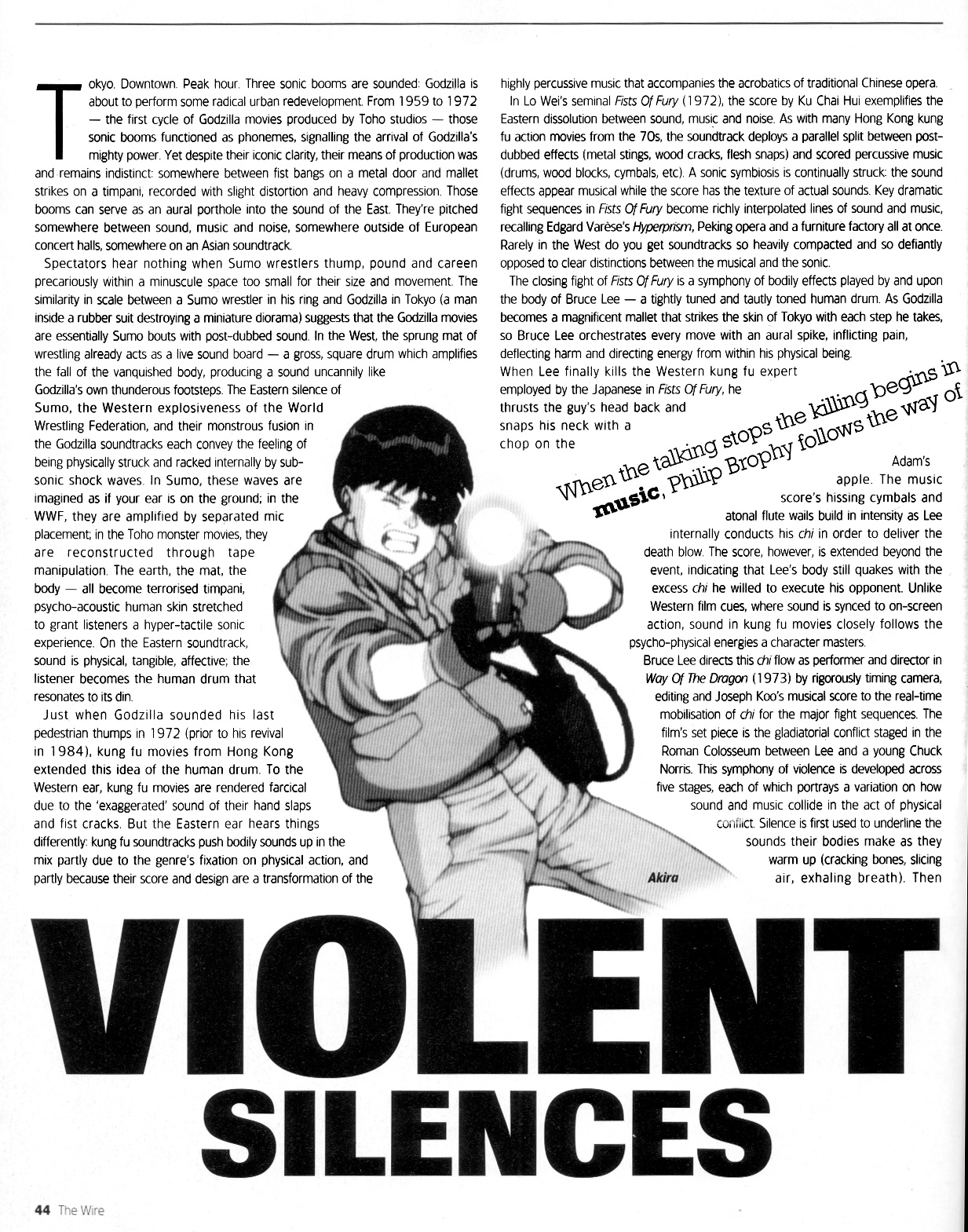
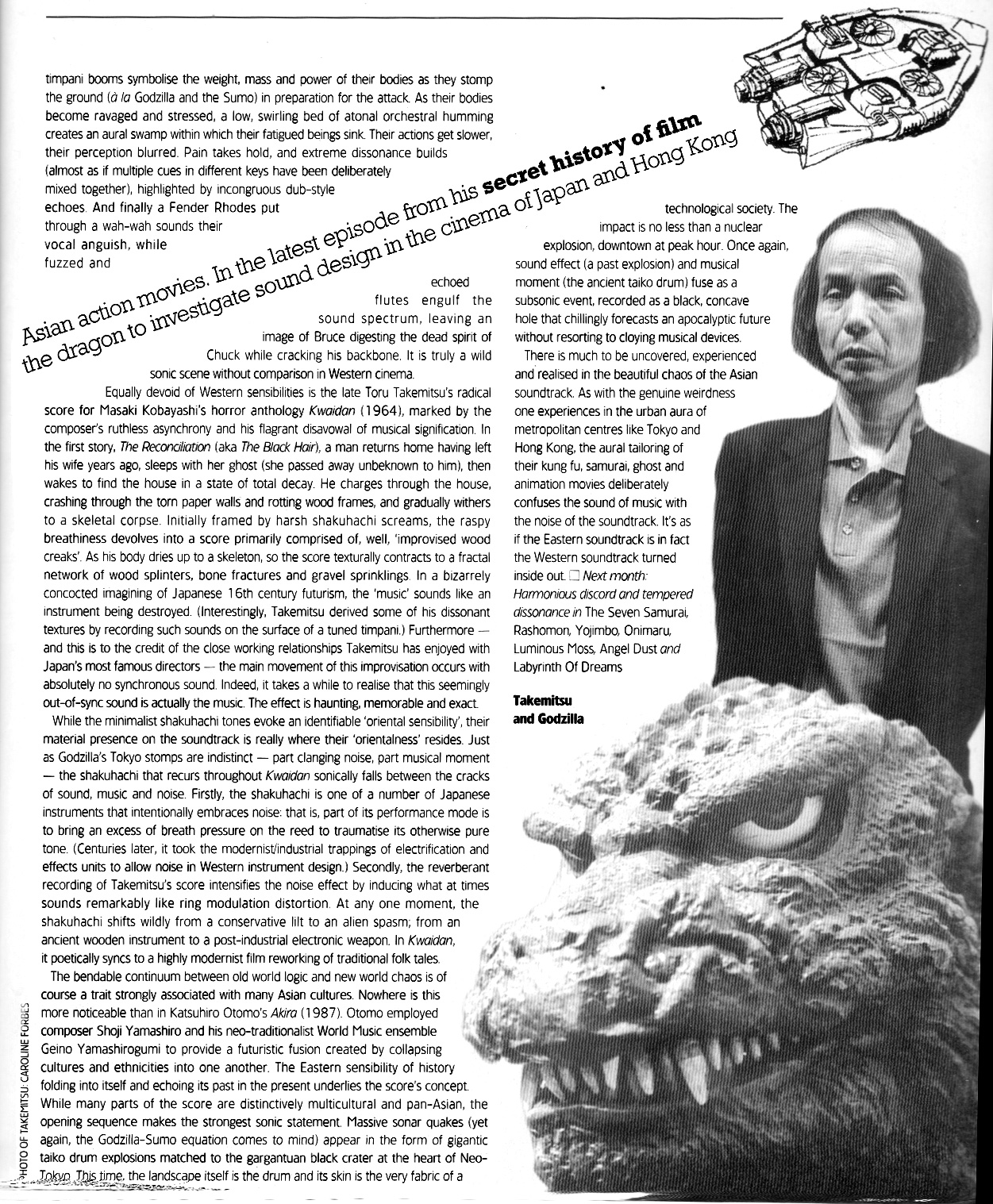
In a series of articles called "The Secret History of Film", Phillip Brophy Chronicles an alternate soundtrack to modern cinema as heard through the ear of a detailed listener and expressive word-smith. I grabbed the article (again) out of an old Wire magazine I had laying around, but have happily stumbled across the entire series via his website available to read. While every article in the series is worth a read, reeling you in with titles like: "Reverberant Oscillators In Outer-Space", "Birth of the Monstrous", "Noise, Noise, Noise", and "Schizo Scherzos & Psycho Synths", the one that hit me like a bullet back in 1997 was "The Skin of the Human Drum" AKA "Violent Silences".

"The end fight of FISTS OF FURY is a symphony of bodily effects played by and upon the body of Bruce Lee - a tightly tuned and tautly toned human drum. As Godzilla becomes a magnificent mallet that strikes the skin of Tokyo with each step he takes, Bruce Lee orchestrates every move with an aural spike, inflicting pain, deflecting harm and directing energy from within his physical being."
I always dig reading peoples creative descriptions of sound and it's great when you stumble across someone who can mirror the intensity of what they're talking about when writing.

Monday, February 15, 2010

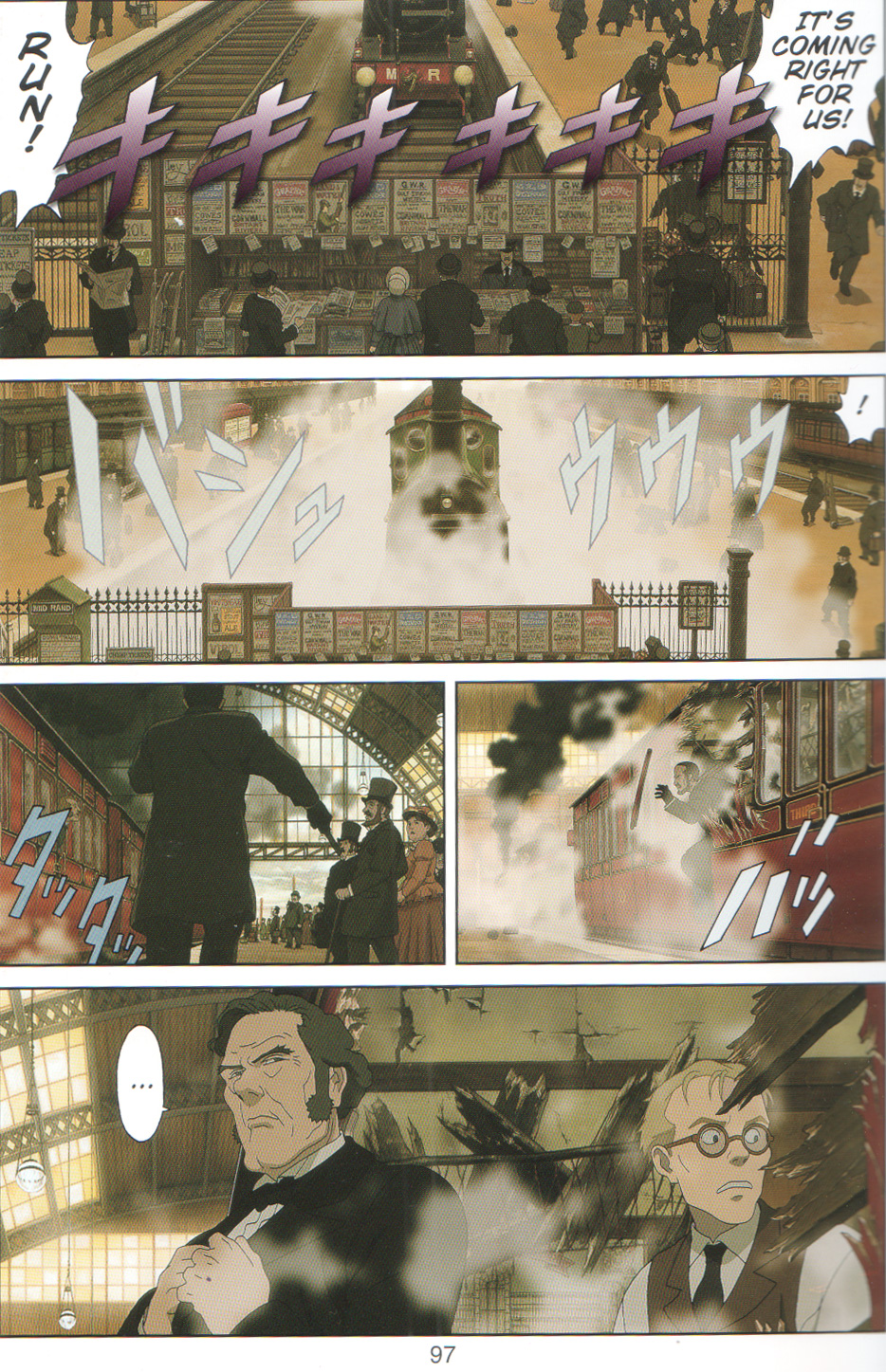
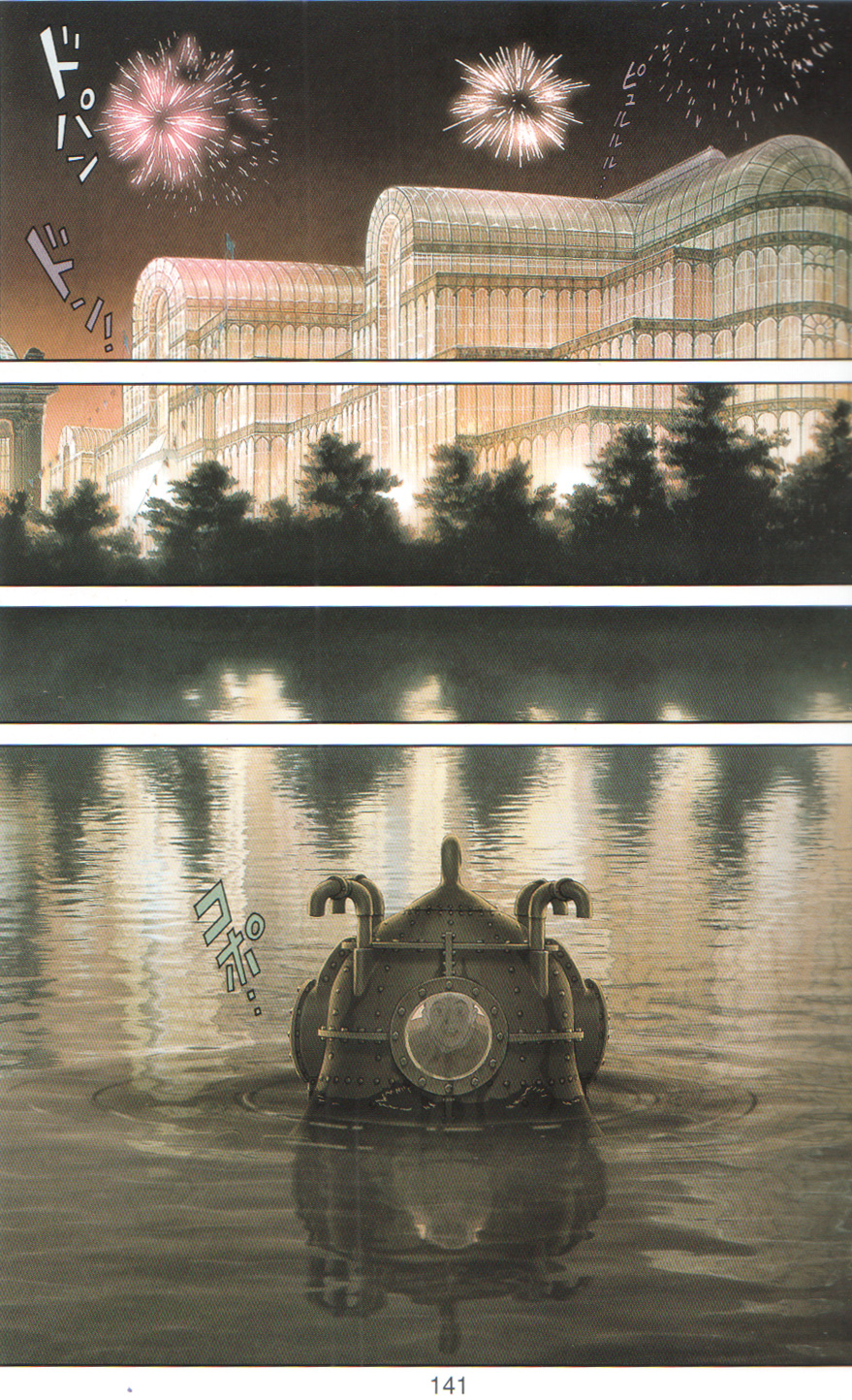
Kanji - Steamboy


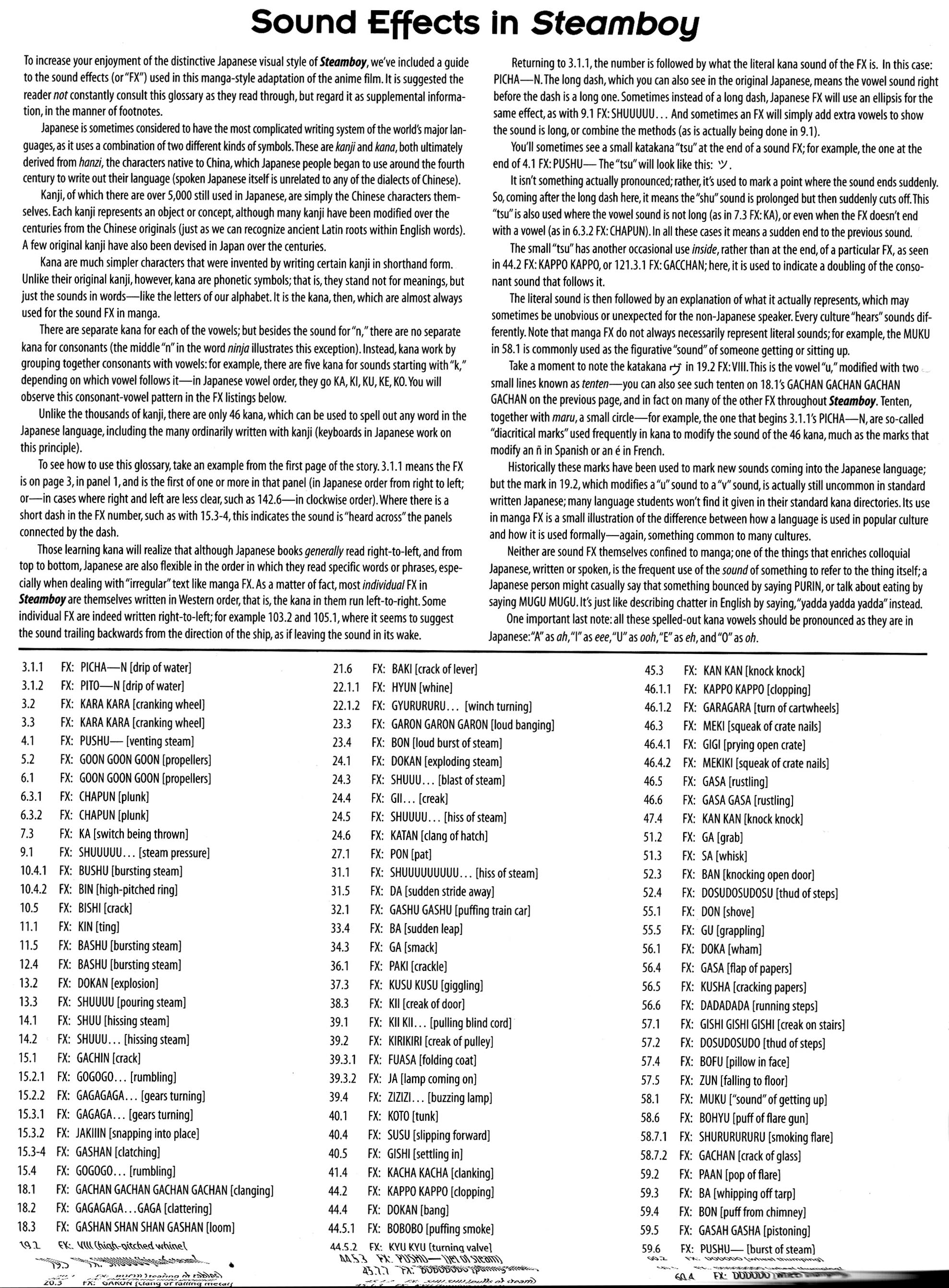
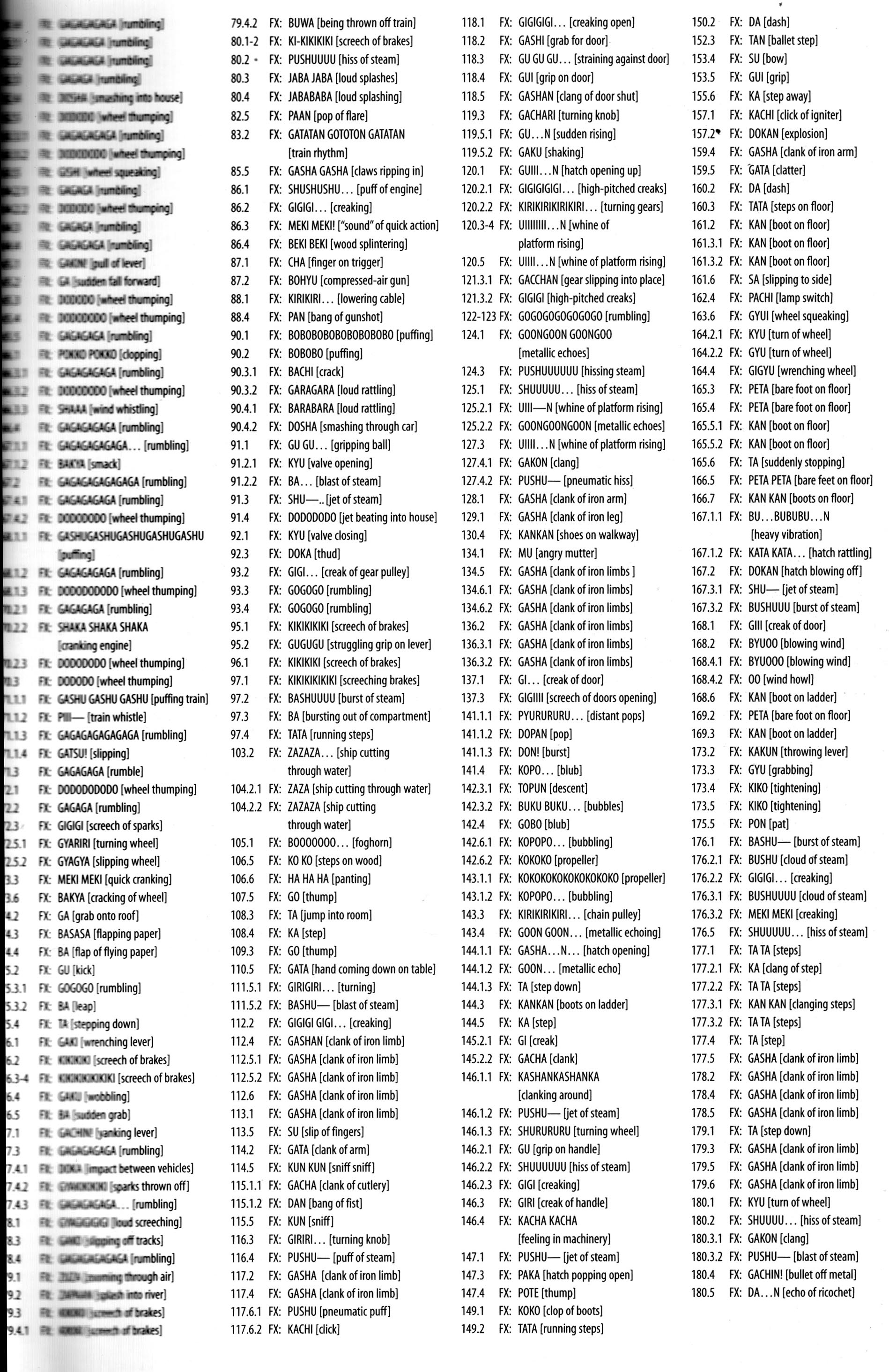
Call me late to the party, but I just made the connection between Japanese Manga 'Kanji' or 'Katakana' and Sound effects. Reading through Steamboy by Katsuhiro Otomo recently, I can across these introduction pages which outline the different symbols and their English translations on a page by page basis. Fascinated by the depth of the characters used, their presentation, and the descriptions I decided to put up a couple example pages to use with the intro.

Take a peek:

The Japanese analogy to the 'boof' -  'bap' -  'pow', and no less awesome!
Now, who's up for some Kanji Invader?